
Web design is evolving at a rapid pace driven by new rendering capabilities in browsers, more rigorous speed standards imposed by search engines, and users’ growing demand for immersive, accessible, and friction-free digital experiences.
1. Extreme Performance and Core Web Vitals as a Design Standard
Visual design can no longer be planned outside of technical speed. In 2026, leading websites are built under lightweight architectures that prioritize optimization of Google’s Core Web Vitals (LCP, INP and CLS): image compression in next-generation formats (WebP and AVIF), optimized rendering and JavaScript code minification to achieve instantaneous load times of less than 1 second.
Through our focus on high-performance professional web design, aesthetics and speed always go hand in hand.
2. Microinteractions and dynamic design with glassmorphism
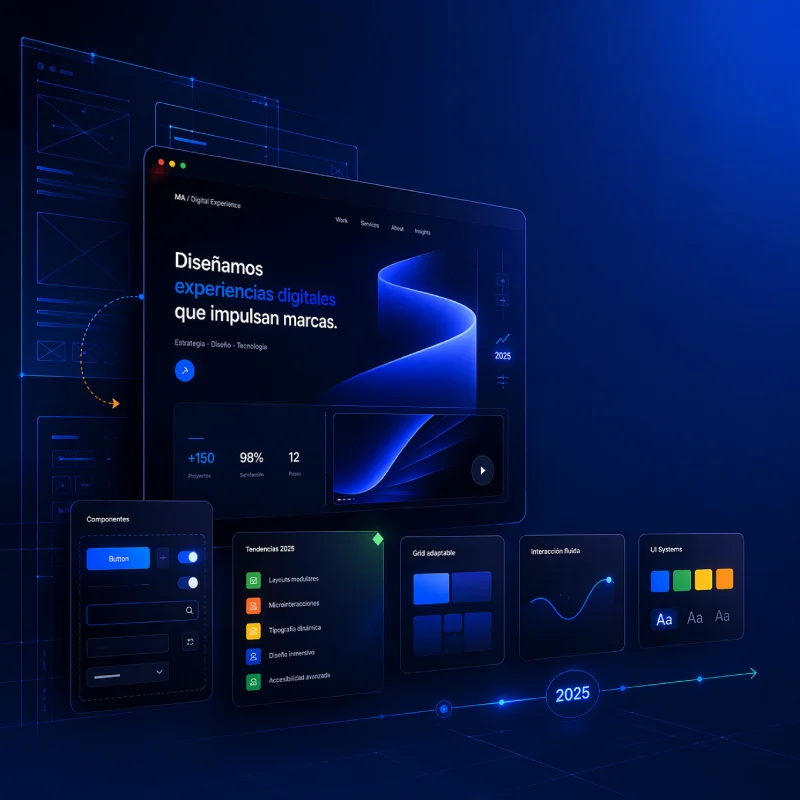
Static interfaces are obsolete. The dominant trends combine visual depth effects with semi-transparent backgrounds (glassmorphism), smooth transitions when scrolling and touch micro-animations that respond to user interaction, guiding their attention to key conversion elements without overloading processor resources.
3. Expressive editorial typography and native dark modes (Dark Mode)
The use of strong fonts with great visual personality allows brands to convey authority and differentiate themselves from generic templates. Additionally, the implementation of native dark color schemes improves readability in low-light environments and reduces battery consumption on smartphone OLED displays.
4. Integration of intelligent agents and personalization with AI
Modern websites incorporate conversational assistants driven by language models connected to the company’s database, capable of resolving complex technical queries, quoting budgets and guiding the user in real time through our intelligent automation solutions.
5. Semantic structure prepared for generative search (GEO)
With the advent of artificial intelligence overviews on Google (AI Overviews), web design must structure content using comprehensive Schema.org structured data to make it easier for search engines to extract direct answers and cite the web as a source of authority.
These innovations are applied in all the projects in our catalog of work and success stories.
Design without redundant code: the rise of Vanilla CSS
Faced with heavy frameworks that slow down browser loading with thousands of lines of unused styles, the trend in 2026 is for pure CSS code, native variables and lightweight modules that reduce the weight of pages to historic lows without giving up an avant-garde aesthetic.
Artificial intelligence applied to accessibility in real time
Modern websites incorporate automatic accessibility accommodations that detect the user’s operating system preferences (high contrast mode, motion reduction, enlarged text size) to natively deliver a personalized ergonomic experience.
Web accessibility as a positioning and conversion factor
Search engines prioritize web pages that comply with WCAG 2.2 accessibility standards: optimal typographic contrast, fluid keyboard navigation and descriptive labels in all interactive elements, expanding the target audience to people with any type of functional diversity.
The rise of voice search and personal assistants
Contemporary web design incorporates responses structured in direct paragraphs that make it easy for assistants like Siri, Alexa or Google Assistant to extract precise information about hours, services and the location of the company when responding to user voice queries.