
Straightforward Digital Transformation: Profitability and Operational Peace of Mind
Running a business in 2026 leaves no room for abstract theories. At the end of the month, what truly matters in any company is profit margins, hours of peaceful sleep gained, and the reassurance of not receiving a penalty notice in your electronic mailbox.
For years, technology was sold as an end in itself, cluttering offices with complex tools and recurring subscription fees that drain cash flow. True digitalization eliminates the repetitive tasks that burn out your team, ensures no quote goes unanswered, and keeps every billed dollar under tight control. To accomplish this, custom web development designed to attract clients and a solid technical infrastructure make all the difference.
Mastering the 10 Keys to Digitalization and Automation in 2026 marks the dividing line between businesses struggling to make ends meet and those operating smoothly, cutting operational costs, and shielding their activity against new regulatory requirements.
Legal and Regulatory Compliance: Invoicing and Labor Tracking
Legal obligations are non-negotiable, and the margin for error has vanished. Public authorities require instant technological transparency, making improvised procedures a liability.
1. Strict Compliance with VeriFactu and Electronic Invoicing
Adapting to certified, verifiable invoicing systems can no longer be delayed. Tax authorities require tamper-proof records, invoice chaining, and real-time traceability. Issuing invoices via spreadsheets or discontinued software exposes your business to severe tax penalties and immediate tax audits.
Implementing software adapted to VeriFactu certifies every transaction instantly, transmitting required data directly to tax authorities and ensuring collection validity. Leaving compliance to the last minute leads to costly disruption and rushed implementations.
2. Certified Digital Time Tracking for Labor Inspections
Labor inspections no longer accept handwritten sign-in sheets or improvised spreadsheets. Current legislation strictly penalizes any system where working hours can be altered retroactively.
A digital clock-in system accessible via mobile phone or workstation eliminates this vulnerability at its source:
- Reliable records of clock-ins, clock-outs, and breaks with secure validation that fully respects employee privacy.
- Automated overtime calculation to prevent workplace disputes and official notices.
- Instant official report generation ready for any unannounced labor inspection visit.
Operational Efficiency and Manual Task Reduction
Your team’s time is your company’s most expensive asset. Wasting it on mechanical tasks erodes internal profitability.
3. Workflow Automation and Account Reconciliation
How many hours a week does your team spend transferring data from delivery notes to invoices or manually reconciling bank payments? Those are wages paid for repetitive chores that bring in zero new customers and add no strategic value.
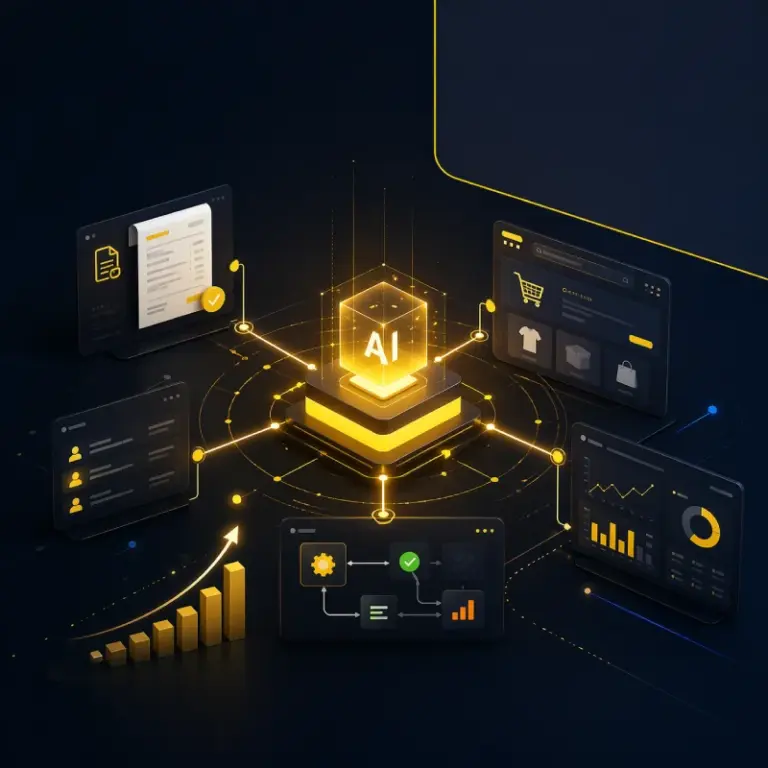
Today, we automate everything from invoices to entire stores with AI: a signed delivery note turns into an invoice with a single click, accounting ledger entries are generated automatically, and clients are notified without manual intervention. The result is immediate: fewer human errors, zero misplaced invoices, and faster cash flow into your bank account.
4. Operational AI Agents for Immediate Customer Support and Quotes
Modern customers will not wait. If it takes a full business day to receive quote information, they will immediately turn to a competitor directly from their smartphone.
Properly implemented artificial intelligence serves as a continuous operational filter capable of:
- Answering frequently asked questions 24/7, every day of the year.
- Gathering technical specifications from prospects before routing leads to sales representatives.
- Instantly generating pre-configured quotes based on standardized price lists.
This guarantees that no business opportunity is lost to an unattended inquiry, allowing your team to focus exclusively on closing high-margin deals.
Continuous Lead Generation and Customer Experience
Optimizing internal operations is futile if the influx of new business stalls. Customer acquisition and checkout experience must work in unison.
5. Conversion-Focused Web Presence and Direct Acquisition
Maintaining a generic corporate website that fails to generate qualified inquiries is an unproductive expense. Your digital footprint must function as an active, round-the-clock sales pipeline.
Achieving this requires a resilient search engine visibility strategy that positions your services right in front of buyers actively searching for a reliable provider.
6. Checkout Experience Optimization and Payment Gateways
In digital commerce and online booking, every unnecessary click causes a direct revenue leak. Optimizing the purchasing experience removes checkout friction, streamlines forms, and simplifies payment gateways to complete transactions in seconds.
Integrating modern payment methods such as corporate Bizum and secure payment processors reduces abandoned carts and accelerates cash flow.
Custom Technology and Proprietary Digital Assets
Over-reliance on generic third-party software often results in unexpected licensing costs and a loss of operational autonomy.
7. Custom Software vs. Restrictive Generic Licenses
Many businesses subscribe to off-the-shelf software packages that charge per-user fees and lock critical features behind paywalls. Over time, the business ends up adapting its workflow to the software, rather than having the tool adapt to the business.
Bespoke software development provides decisive advantages for long-term operational health:
- Complete system ownership with zero recurring license fees inflating expenses year after year.
- Tailor-made design built precisely around your company’s daily workflow.
- Modular scalability, expanding functionality only when your business requires it.
8. Modern Platforms and User-Centered Functional Design
User expectations continue to rise, and visitors do not tolerate slow or confusing websites. Implementing modern web design trends is not about complex animations—it is about delivering instant loading speeds, intuitive navigation, and clear presentation of services.
A modern, well-structured platform projects credibility and builds the trust required to win high-value contracts.
Business Continuity and Hands-on Technical Support
Technology is only as reliable as the security protecting it and the human team standing behind it when issues arise.
9. Data Security and Redundant Backup Protocols
A hardware failure, accidental deletion, or cyber incident can paralyze operations for weeks. Losing customer databases, invoices, or pending orders is a blow no insurance policy fully covers.
Setting up automated, encrypted backups on remote servers ensures operations can resume within minutes without data loss or damage to your company’s reputation.
10. Direct Business-to-Business Partnership in Sanlúcar and Cádiz
The final and most decisive key is the human factor. Technological solutions often fail when backed only by impersonal call centers or support tickets that take days to receive a reply.
Partnering with a local technical team in Sanlúcar de Barrameda and the province of Cádiz—one that speaks your language and understands the real challenges of the local business community—provides genuine peace of mind. Meeting face-to-face, analyzing business bottlenecks, and deploying tested, practical solutions is the best way to achieve digital transformation with proven ROI.
Frequently Asked Questions
Is VeriFactu implementation mandatory for all businesses in 2026?
Yes, national regulations on electronic invoicing and certified billing systems establish binding deadlines for corporations and sole proprietors. Adapting early avoids tax penalties and ensures uninterrupted day-to-day invoicing.
What is the difference between custom software and off-the-shelf commercial tools?
Custom software is engineered specifically around your company’s internal workflows, free from recurring monthly license fees or bloated, unnecessary features. Your business owns the code, and it evolves at the pace of your operational needs.
How long does it take to automate a traditional business?
Implementation is rolled out in practical phases to prevent any disruption to daily operations. High-priority workflows such as digital time tracking or invoicing can be deployed in just days, while comprehensive system integrations are rolled out progressively.
How does digitalization guarantee a tangible return on investment?
ROI is realized immediately through drastic reductions in manual labor hours, the elimination of costly errors in quotes and orders, and consistent customer acquisition through optimized digital sales channels.